Article ·
Silent Witness
Why Your Dog Knows More About Your Break-Up Than You Do
I recently met a lady who was dealing with the pain of a recent relationship break up.
Although she hadn’t been dating the guy for very long, she was surprised by just how much pain she felt as the relationship ended. She felt foolish for investing so much so soon and in the absence of the insight that she needed to make sense of the break-up; she blamed herself for being a poor judge of character.
As she reflected back upon how hopeful she had been, that he might have been “the one”, and criticised herself for not seeing the break up coming, she noted that even her dogs seemed to be a better judge of character than she was. She recalled how the dogs had reacted anxiously or withdrawn whenever he visited her house, and described their uncharacteristic whining on the evening that he broke up with her.
Speculating on the reason for their behaviour, she asked me if I believed that dogs possessed psychic powers. The kind of powers that enabled them to see the break up coming before she did.
As soon as she uttered the question, she made light of it, joking in the way that we do, when the pain that we experience makes us suddenly feel insecure, before changing the subject and going on her way.
But I knew that it was a genuine question, from someone who was trying to learn from a painful experience, and one that deserved a genuine answer. An answer that I never got to give.
So, here it is, my genuine answer.
My genuine answer is no.
I don’t believe that dogs have the ability to see into the future.
But they do possess powers even more incredible than precognition.
And although they may not possess extra sensory perception, they do possess a level of sensory perception which is quite extraordinary and far superior to our own.
So, although this lady’s dogs couldn’t see that the break up was about to happen, they would certainly be capable of sensing that something definitely was.
Therefore, perhaps a more revealing question is, if the dogs were able to sense that all was not well in this relationship, why did it come as such a surprise to their owner?
The Fantasy Bond and Why it Matters
There is a saying that love is blind and if that is true then it is fair to say that the hope of love can cause us to be equally short sighted. Our inability to see clearly in matters of the heart is often driven by a combination of hard-wired survival instincts, childhood experiences and the way that our brain processes hope and pain.
When we fall in love with what a relationship could be, we are essentially falling in love with what we want it to be in order to fulfil a basic human need. So, investing in a relationship’s potential while ignoring its reality is a psychological mechanism which allows us to protect ourselves from the painful truth of the present moment.
Psychologist Robert Firestone, referred to this process as fantasy bonding to describe the way that we often enter relationships with a pre-conceived idea of what our life should look like. When we meet someone who has the potential to tick those boxes, we project our expectations onto them, and unconsciously focus our efforts on making our fantasy a reality.
In the early stages of a relationship, our brains are flooded with dopamine and oxytocin. These hormones cause us to associate the relationship as the source of happiness and love. This can distort our perception of the true depth of the relationship and the reality of the relationship dynamic. When evidence of incompatibility does appear and reality begins to clash with this image, it is less painful to deny it or explain it away than to face the disappointment that this relationship isn’t working.
As our early childhood experiences often dictate how we handle relationship difficulties, then those of us that had to earn love or keep the peace as a child may have a tendency to ignore red flags in favour of maintaining the relationship. In addition, if we have a deep fear of failure or rejection, then forcing ourselves to focus on a hopeful future is an active defence mechanism against the distressing feelings of disappointment and abandonment.
Unfortunately, as in the case of this lady, this strategy only achieves minimal short-term gains as the pain of an incompatible relationship and the inevitable break up seems unavoidable.
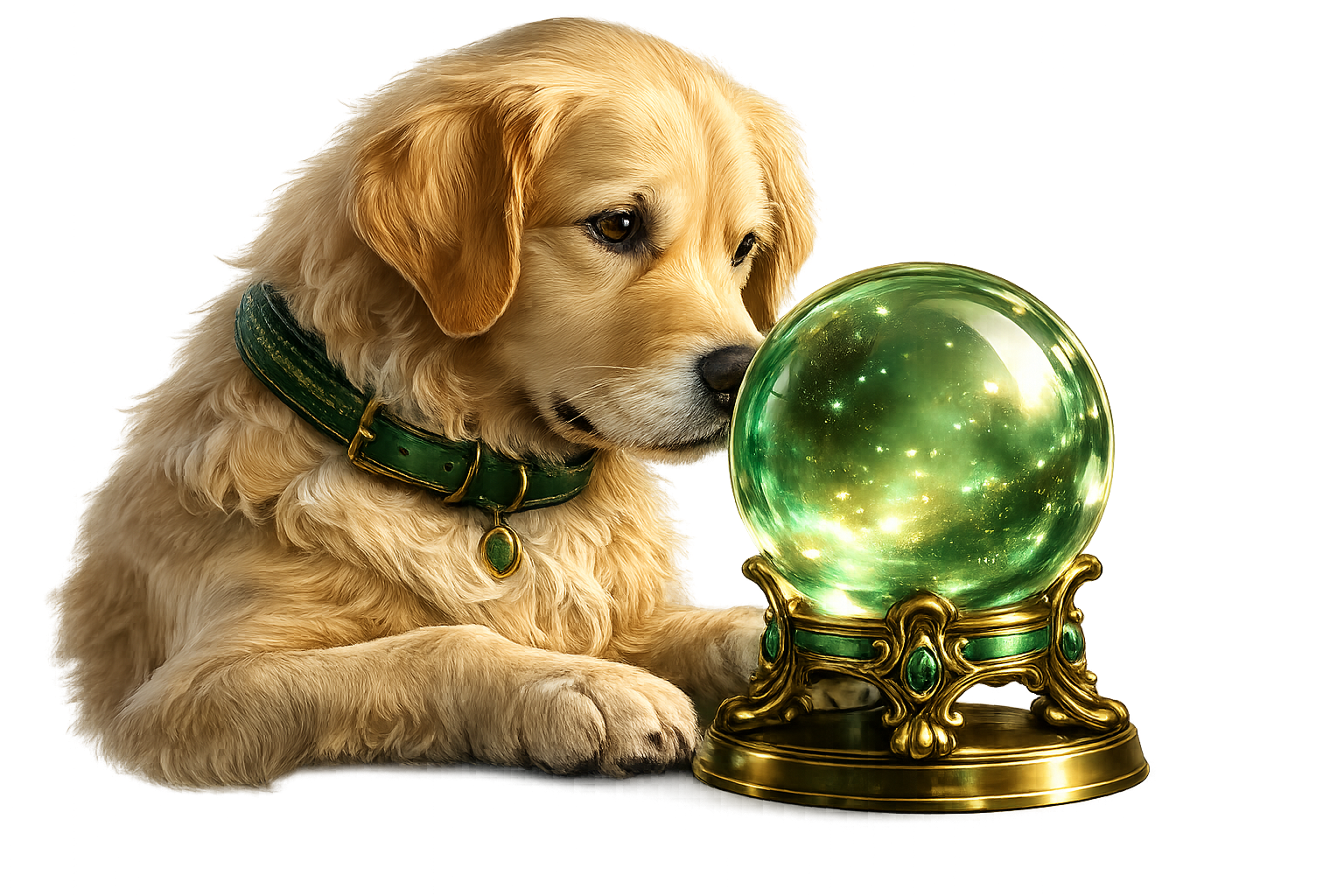
Why Dogs don’t need a Crystal Ball
The science behind why this lady’s dogs reacted in a way which suggested that they had a more accurate understanding of her relationship than she did relies on three interconnected biological fields: canine olfaction, evolutionary biology, and neuroendocrinology.
When we instinctively know that a relationship is wrong but suppress those feelings in the hope that things will turn out right in the end, our sympathetic nervous system activates a low-grade, persistent "fight-or-flight" response. As the brain's amygdala prepares to protect itself from the pain of disconnection and the fear of loss, it signals the adrenal glands to release cortisol, adrenaline, and noradrenaline. These hormones alter a person's sweat, breath, and pheromones. Dogs possess an olfactory system up to 100,000 times more sensitive than a human's nose, alongside the Vomeronasal Organ (Jacobson's Organ), which is specifically designed to detect intangible, emotional pheromones.
So, although their owner may have appeared happy and relaxed around her new partner, her dogs would be able to smell a high-cortisol, chemical signature of fear and inner conflict. In addition, domestic dogs share a unique evolutionary bond with humans that includes emotional contagion—the phenomenon where one individual's emotions trigger similar emotions in another. This is the result of mirror neurons within their brain that allow them to read and respond to state changes in other dogs and also to mirror human emotional states.
So, while the human mind can use logic, hope, and rationalisation to ignore red flags, the human endocrine system always tells the truth. The dogs simply read the body language, muscle tensions, vocal tones and chemical reality of both the humans in the room and acted out their instinctive behaviours in response to it.
Why Choice is the card that trumps Canine Clairvoyance
The ability of this lady’s dogs to accurately read the room does not require them to possess the gift of clairvoyance. But it does require them to possess a level of awareness that gives them the gift of clarity.
No matter how insightful, perceptive or level-headed we may be when managing our professional or domestic life, our emotional life is often the place where we lack the clarity that we need. It is the place where our survival instincts, our childhood experiences and our limiting beliefs can take hold and our basic human needs for love and acceptance can undermine our logic and objectivity.
Because when our vision is clouded by our hopes and fears, we lose the ability to recognise the relationship for what it is and not what we want it to be. As a result, it’s easy to find ourselves going through the same dating pattern of start-ups and break ups, without understanding why.
The simple solution would be to take a step back and enlist the support of someone that we can trust. Who, like our pets, won't judge us or tell us what to do.
Someone with whom we can feel safe to express our emotions and take an honest look at ourselves in order to help us discover what we really want from a relationship. Someone who enables us to gain deeper insight, self-awareness and most important of all, to recognise the patterns of behaviour that cause us to keep repeating the same painful patterns.
Because when we can gain the same level of clarity that this lady’s dogs possessed, we can be honest with ourselves about what we need, and what we have to offer another person. This self-awareness enables us to identify new opportunities to connect with the person we want to be with and avoid repeating the same emotional experiences.
Reflection
Perhaps the greatest challenge that we face when navigating our relationships is our ability to focus on the present reality, rather than our hopes of what the relationship might develop into.
That’s where dogs have the edge. Dogs live in the moment and respond to the reality of the situation as it evolves.
They trust their natural instincts, recognising instantly if someone makes them feel safe and happy and reacting just as quickly if they don’t.
As human beings with beliefs, baggage and a need to love and be loved, we can often suppress our natural instincts and attempt to ignore or reason away something that doesn’t feel right. We focus on a vision of the future in order to accommodate and tolerate the difficulties and disappointment of the present.
And in doing so, we lose sight of our reality and of the choices available to us.
So perhaps the most valuable lessons we can learn from our pets is to stay in the moment, to trust our instincts and use them to establish greater clarity. Because our clarity reveals the variety of choices available to us and greater choices create new possibilities of finding the right relationship for us.
Before you go,
Do you think that dogs are better judges of character than we are?
Or do they simply possess a level of clarity that we are all able to acquire?
Which situation in your life requires more clarity?
And what would developing that clarity enable you to do, that you can’t do now?
"You have been reading The Silent Witness, conceived and written by Susan Doherty.
This original work remains the intellectual property of Susan Doherty and may not be reproduced or presented as the work of another without permission."
Susan Doherty is a professional coach, development specialist and practitioner of NLP. Originally trained as a Neuro-Linguistic Programming Practitioner by Richard Bandler and as a hypnotherapist by Paul McKenna, she specialises in working with motivated clients who are driven by a desire to understand themselves and others, courageous enough to challenge established thought patterns and ready to explore new possibilities.
CONTINUE THE EXPLORATION
If you enjoy exploring the psychology behind who we are and what we do, you can follow me on LinkedIn where I regularly share my observations, insights and questions designed to challenge our thinking and encourage new perspectives.
LET’S TALK
If this article has prompted you to question your own situation or future direction, then perhaps it is time to explore them from a different perspective.
Arrange a confidential, no-obligation conversation with me and discover what new possibilities may become available when you have more clarity and more choice.