Article ·
Serial Sleuthing
Why the Clues to Our Own Mysteries Are Often the Hardest to Spot
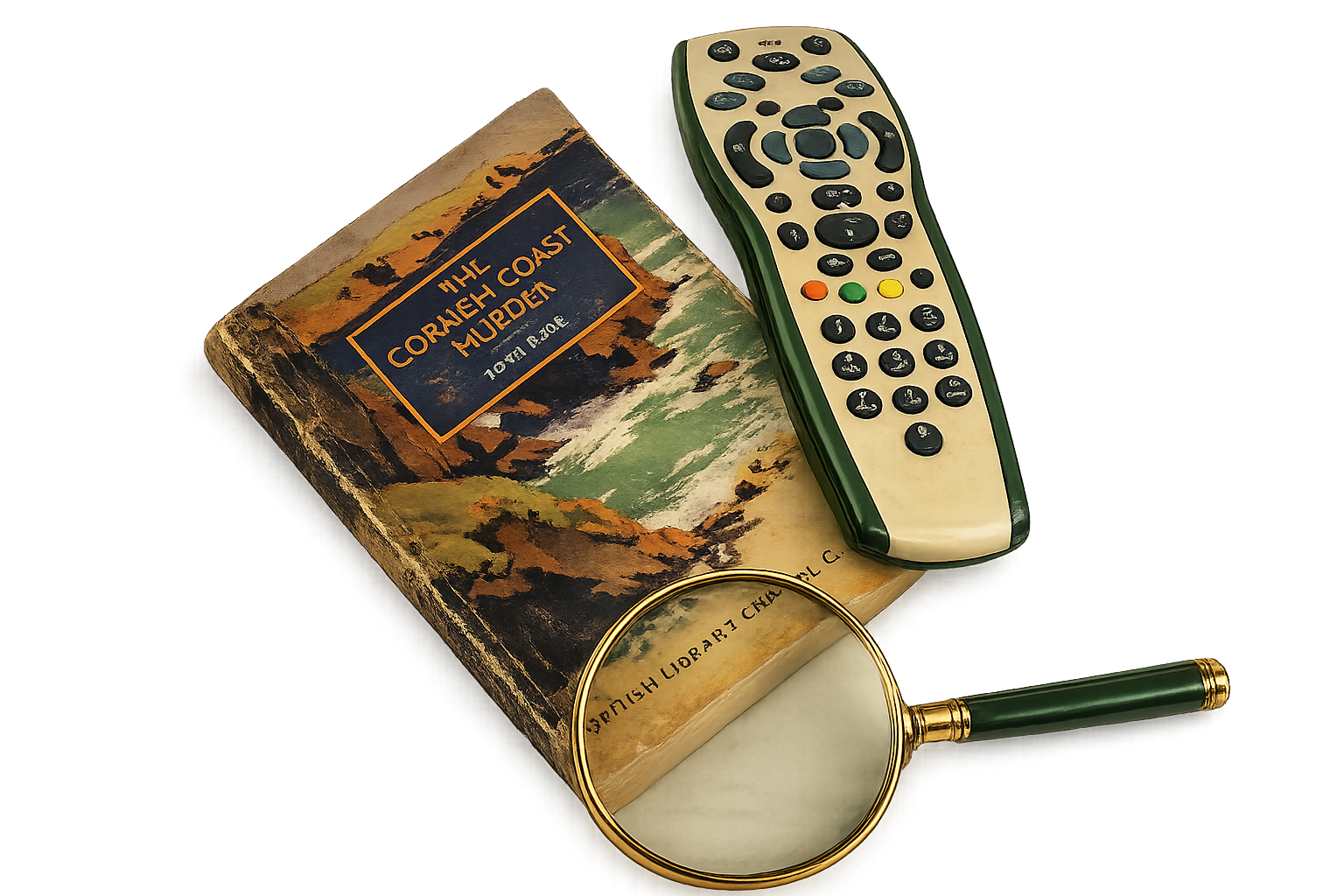
I love a good murder mystery. The more intriguing the better. Carefully planted clues, a bunch of unlikely suspects, plenty of plot twists and the occasional red herring. Perhaps that’s because I've always been a fan of puzzles. Particularly the ones that are people puzzles. The ones that require us to see beyond the obvious and attempt to miss direct us. I’m what you might call a Serial Sleuth.
I never seem to tire of them. Which is probably a good thing as the TV channels broadcast an endless stream of twisty dramas, forensic cold cases and cosy murder mysteries, night after night. As millions of us settle down to an evening of solving crimes that range from the crazy to the complex, just before the detective does. We delight in spotting each suspicious glance or inconsistent alibi and accusing or eliminating suspects from the comfort of our sofas.
From the Golden Age of detective fiction to the grittiest Nordic Noir, the most successful crime fiction includes a formidable crime fighting partnership. The civilian sleuth with the unlikely sidekick and the dogged detective and their unconventional sergeant. A thinking partner and co-collaborator, who sees the world differently. And as a result, their combined perspectives and deductive conversations reveal the insight their audience needs in order to solve the crime.
It’s an old established formula that, if followed, works perfectly every time. As we settle down to a satisfying evening of just the right level of intellectual challenge and suspense, we are safe in the knowledge that every mystery has resolution. We know that with sufficient curiosity, careful observation and a bit of lateral thinking, even the most impossible puzzles and implausible crimes can eventually make sense.
If only real-life puzzles were so conveniently solvable.
While watching the closing credits roll on one of my favourite crime dramas, I found myself reflecting on a conversation that I’d had with a friend who enjoys solving fictional mysteries as much as I do. At the end of one of our recent get-togethers, she asked me a really great question, why is she so much better at solving other people’s problems than solving the mysteries and dramas in her own life?
Experience has taught me that one explanation is that we are often too emotionally invested in a situation to risk challenging it. Another is that our hopes and fears combine to cloud our judgment or our unchallenged assumptions prevent us from even suspecting that a difficult situation has the potential to be resolved.
Although all these explanations have the potential to answer my friend’s question, they only serve to offer a clearer understanding of the problem, not how to resolve it.
For that, we need to identify the secret sleuthing weapon, consistent in all the best whodunits.
The unconventional thinking partner.
The one that asks the question that completely changes the game.
Nothing new has been discovered. The answer was always there, but the question made it visible.
Why the Brain Loves the Breakthrough
I've always found that turning point in a story to be the most satisfying. The moment when the sleuth is stuck and finding the solution seems impossible. Then suddenly the breakthrough happens. Everything clicks into place and the crime fighting duo are galvanised into action.
But there is a reason why we find this familiar story telling convention so satisfying, and it's more than just the exciting plot point that signals the dramatic climax.
It’s also a powerful signal to our brains.
Thanks to the research of Neurobiologists like Dr Michael Yassa, we now understand how the brain navigates memory and records information in story structured narratives, that are essential for our growth and survival.
Our brains have evolved to ensure our survival by constantly analysing, evaluating and recording a massive amount of sensory information in an attempt to predict what will happen next, as a means to keep us safe. In order to do this efficiently the brain takes shortcuts, deleting, storing and organising our experiences into different parts of our brain. But when we experience workload stress, relationship tension or personal frustration, our brains can get stuck in a cognitive rut which keeps repeating the same unresolved, dead end thought patterns over and over again.
Our brain views this unresolved thought loop as an active threat to our progress, resulting in anxiety, mental fatigue, and a heavy feeling of defeat.
A well written murder mystery intentionally causes us to experience a version of that same unresolved loop. As seasoned sofa sleuths we know the crime must be solved by the time the final closing credits roll.
But still, we find ourselves wondering how?
We’ve seen all the clues, heard all the alibis and ruled out all the suspects.
None of them could have done it… But one of them must have.
So, when the detective's thinking partner asks that unexpected question, the one that stops the detective in their tracks, they disrupt that unresolved thought loop and trigger a sudden spike in high-frequency Gamma brain waves. This is the neurological equivalent of a lightning bolt, which instantly forges new connections between pieces of information stored in different parts of the brain.
Our brains experience this rapid reorganisation as a profound sense of clarity, accompanied by a rush of dopamine. It feels instantly satisfying because our brain has just successfully solved the problem, restored a sense of order, and mapped out a path to safe resolution.
Disrupting the thought loop.
It’s easy to see why sticking to the tried and tested formula of the perfect murder mystery is so important for the crime writer, if the story is to deliver the experience that our brains are wired to receive. But in real life, whenever we get stuck in an unresolved thought loop and become trapped inside the mystery of our own inner world, we assume that we are the only ones who can solve it.
And we are right. We are.
So, it’s worth noting that although the most successful fictional sleuths never work alone, they don’t expect their sidekicks to solve their mysteries for them.
Because they recognise that just like us, they already have all the information that they need.
They just need someone they can trust to ask them the right questions.
Someone with the insight to cut through the emotional smog that clouds the problem.
A collaborative thinking partner who can disrupt their unresourceful thought loops and inspire informed and decisive action.
But the idea that two minds are better than one isn’t just a fiction writers’ cliché.
The recognition that our thinking isn't always the most insightful or productive when practiced as a solitary activity is evident within a number of research studies. In psychology, the evidence that our thought process can be extended and enriched through interaction with other people is referred to as distributed cognition.
This psychological theory recognises that when we explore our experiences, thoughts and ideas with an engaged, invested and trusted thinking partner, our conversation isn’t simply an exchange of information; it can actually serve as the thunderbolt we need to reorganise the information in our brains, and positively reshape the way we see what we already know.
Reflection
If the secret to solving our own puzzles lies in the questioning power of a trusted thinking partner, it’s not surprising that so many solo sleuths struggle to recognise what they already know about themselves, or find solutions to their own problems as easily as they solve other peoples.
And if our most transformative conversations result not from someone providing the answers but from being asked the right questions, to expose assumptions we didn't realise we were making. Then where can we find the partner with the questions that encourage us to think about our situation from a fresh perspective?
One of the most consistent observations in my coaching experience is that my clients possess all the resources and the creative solutions that they need.
They simply lack the lightning bolt that suddenly illuminates them.
When they see things more clearly, new choices begin to emerge.
And a greater variety of choices highlights new possibilities and reveals fresh opportunities that were always there, but hidden by the way they were looking at the evidence.
Perhaps the real lesson that our passion for crime solving has been trying to teach us is that our brains need more stimulation, not more information in order to crack our most challenging cases.
Before you go,
If the most accomplished fictional crime writers and psychologists recognise the value of a trusted thinking partner, why are so many of us convinced we should solve life's most important mysteries alone?
And if you don’t need anyone to give you the answers, do you need them to illuminate what you already know?
When you are locked in an unresolved thought loop, what’s the question that you need to break free?
"You have been reading The Serial Sleuth, written and conceived by Susan Doherty.
This original work remains the intellectual property of Susan Doherty and may not be reproduced or presented as the work of another without permission."
Susan Doherty is a professional coach, development specialist and practitioner of NLP. Originally trained as a Neuro-Linguistic Programming Practitioner by Richard Bandler and as a hypnotherapist by Paul McKenna, she specialises in working with motivated clients who are driven by a desire to understand themselves and others, courageous enough to challenge established thought patterns and ready to explore new possibilities.
CONTINUE THE EXPLORATION
If you enjoy exploring the psychology behind who we are and what we do, you can follow me on LinkedIn where I regularly share my observations, insights and questions designed to challenge our thinking and encourage new perspectives.
LET’S TALK
If this article has prompted you to question your own situation or future direction, then perhaps it is time to explore them from a different perspective.
Arrange a confidential, no-obligation conversation with me and discover what new possibilities may become available when you have more clarity and more choice.